TL;DR
- GEO is SEO: Google's own guide, updated in July 2026, calls optimizing for AI search "still SEO".
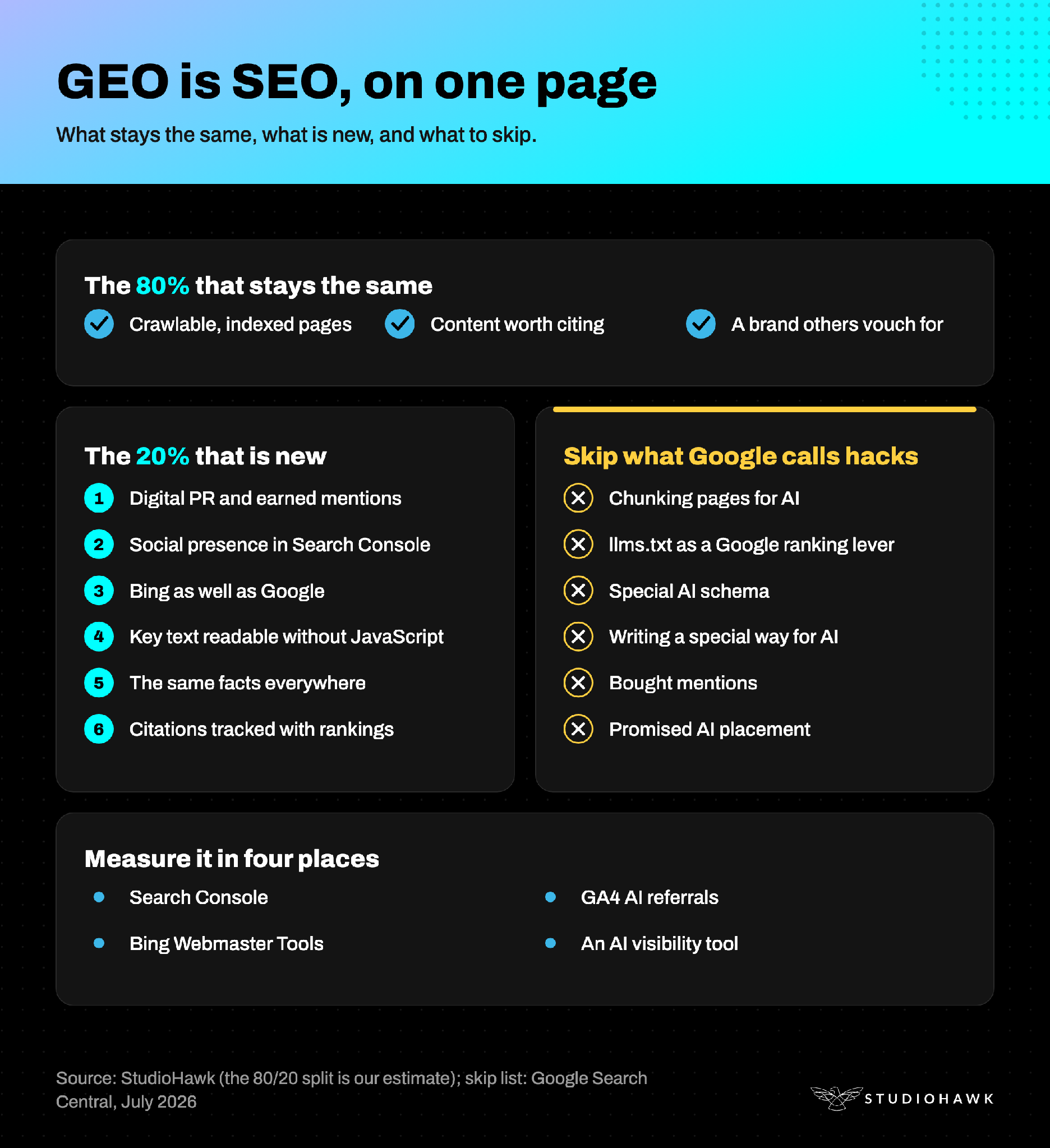
- We put about 80% of GEO down to the same fundamentals: pages that can be found, content worth citing and a brand others vouch for, the other 20% is newer work, led by strategies like digital PR for off-site mentions
- Skip the hacks Google names, such as chunking and llms.txt, and measure what is new.
GEO is SEO.
By our estimate, about 80% of it is the same fundamentals: pages Google and AI tools can crawl, content worth citing, and a brand other sites vouch for.
The other 20% is newer work, and every piece of it traces back to one of those fundamentals.
What is generative engine optimization (GEO)?
Generative engine optimization is optimizing your website and brand so AI tools mention you in their answers.
That covers Google's AI Overviews and AI Mode, ChatGPT, Perplexity, Gemini and Copilot.
When someone asks ChatGPT for the best accountant in Denver, GEO is the work that decides whether your name comes back.
You will see the same practice under other names: answer engine optimization (AEO), AI SEO, LLM SEO and AI search optimization.
They are five names for one practice, and the acronym changes every quarter while the work underneath stays put.
Most of the confusion about GEO and SEO comes down to how much of the work is new.
Is GEO different from SEO?
GEO is SEO, and Google now says so in writing.
Google's guide to optimizing for AI features says those features are "rooted in our core Search ranking and quality systems".
The guide, last updated on July 10, 2026, calls optimizing for them "still SEO".
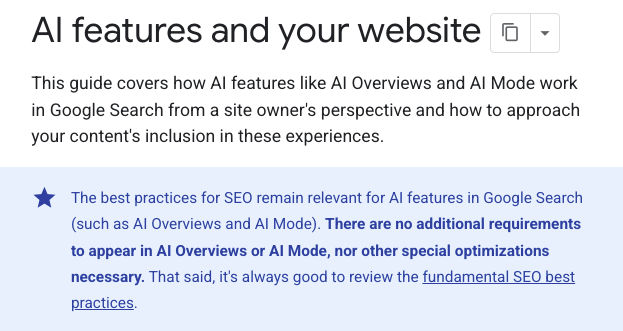
The guide also sets an entry ticket.
To appear in an AI feature, "a page must be indexed and eligible to be shown in Google Search with a snippet".
Only a page Google can index, and show with a snippet, appears in its AI answers.
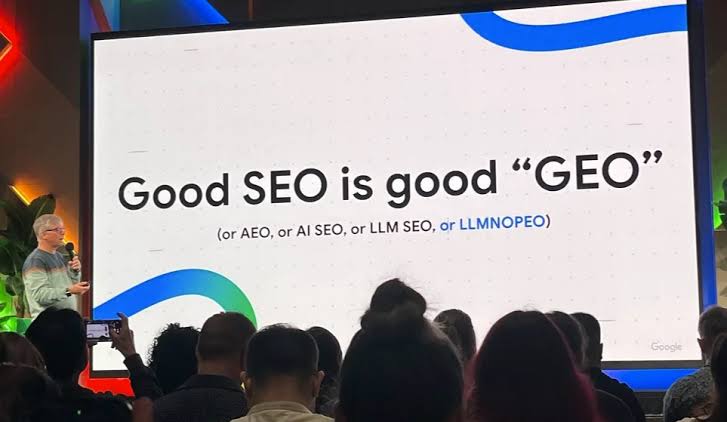
Google has said it on stage too: “Good SEO is good GEO” was a slide at its Search Central Live events:
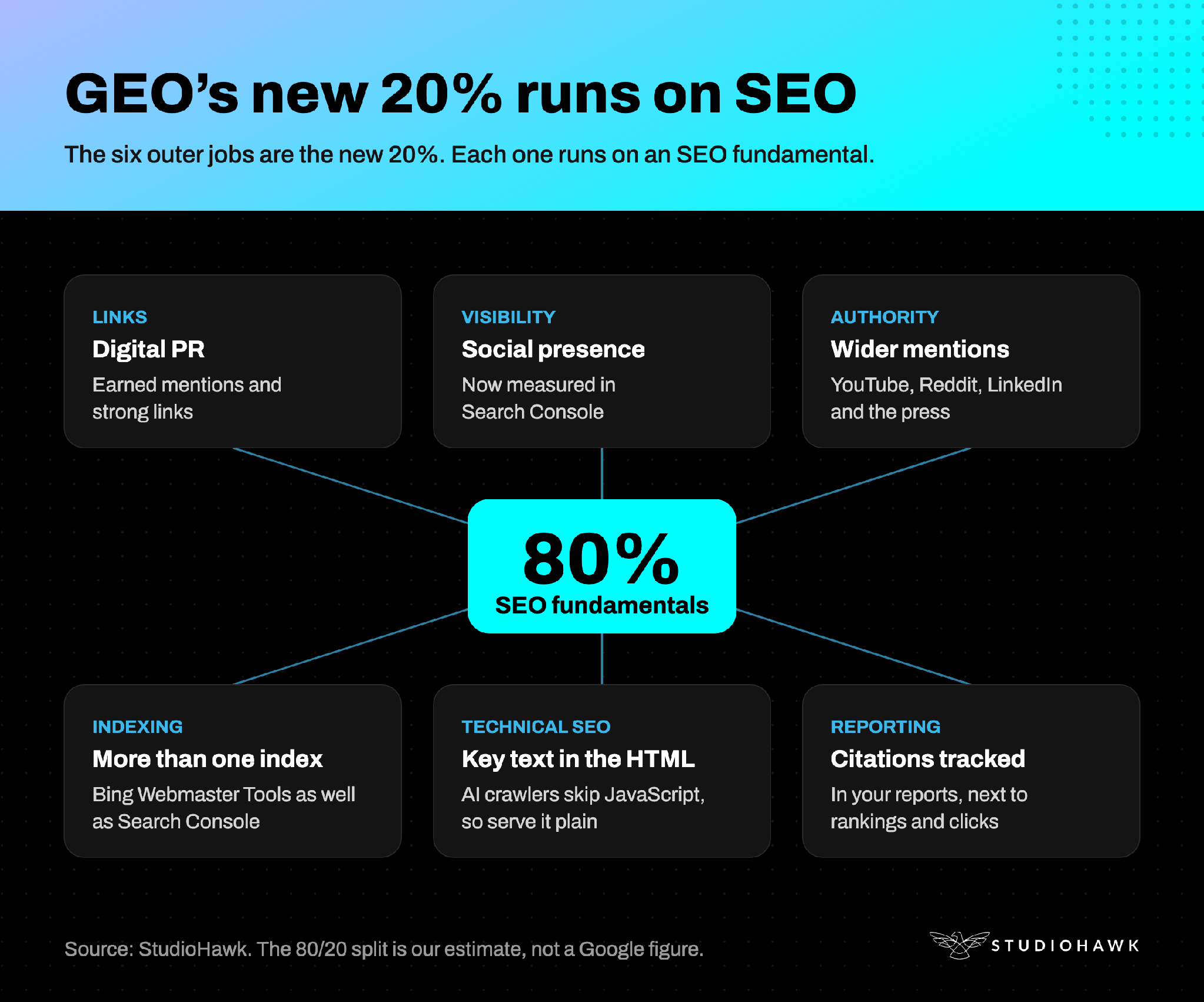
That is why we put the split at roughly 80/20.
Most of what wins in AI answers is the work that already wins in search. The rest is newer, but every part of it leans on something SEO built first.
What stays the same in GEO? The 80%
The 80% of GEO that stays the same is crawlable pages, content worth citing and a trusted brand.
These are the jobs SEO has always done, and AI tools reward them for the same reasons Google does.
Pages that can be crawled and indexed
An AI tool can only quote a page it can reach. Crawling, indexing, site speed and clean site structure all still decide whether your content is in the running.
Our own data shows how far the basics carry.
Across the websites in our analytics data, pages with readable URLs earned about 13 times more AI referral visits per page than pages with unreadable ones.
Part of that gap is intent: the unreadable URLs sit mostly on cart and account pages, which nobody asks an AI about.
Content worth citing
Google's guide asks for "non-commodity content": expert, first-hand material that goes beyond common knowledge.
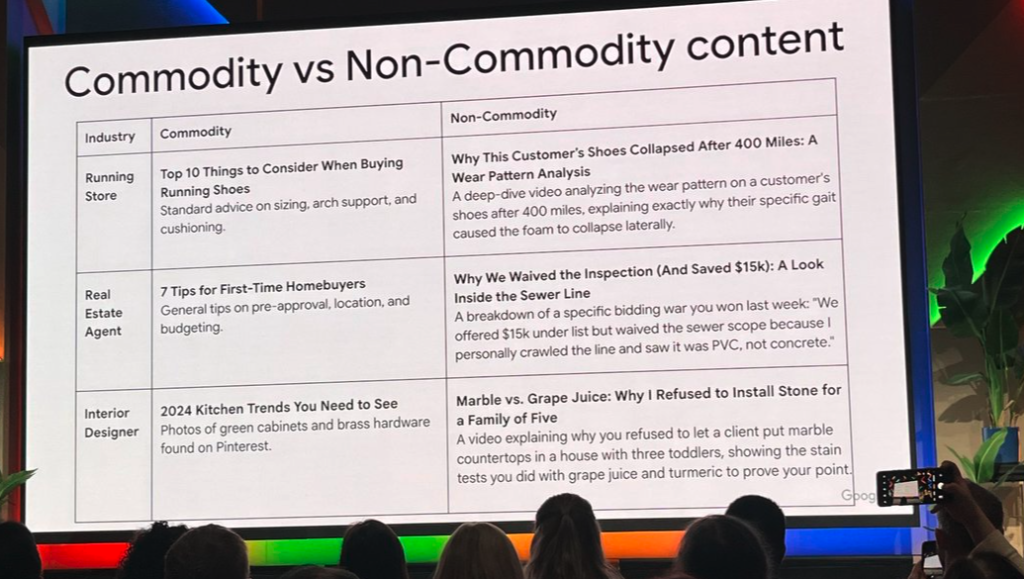
An AI tool has already read the generic version of your article a thousand times. It cites the page that adds something.
A brand other sites vouch for
Links, reviews and mentions tell Google which brands to trust. AI tools read the same signals.
A brand nobody else talks about rarely makes the shortlist an AI gives back.
What is new in GEO? The 20%, and where each part comes from
The new 20% of GEO is a set of jobs that push your brand beyond your own website, and each one traces back to an SEO fundamental.
Digital PR is the one that moves the needle most for our clients, because it earns mentions and builds strong links at the same time. Link building is SEO.
Earned mentions where AI answers look
AI answers draw on sources well beyond your website: news sites, YouTube, Reddit, Wikipedia, LinkedIn, Instagram, review sites and industry press.
Digital PR is the most reliable way to earn a place in them.
The word that matters is "earned"
Google's guide says chasing "inauthentic mentions" across the web is less helpful than it looks.
Wikipedia is volunteer-edited and removes promotional entries.
Bought mentions get removed, and they do little while they last.
Platforms also shift under you so there's a need to continually create more genuine mentions of your brand.
In August 2026, tracking firm Promptwatch reported Reddit's share of ChatGPT Search citations falling from about 3.8% to about 0.5% within a week.
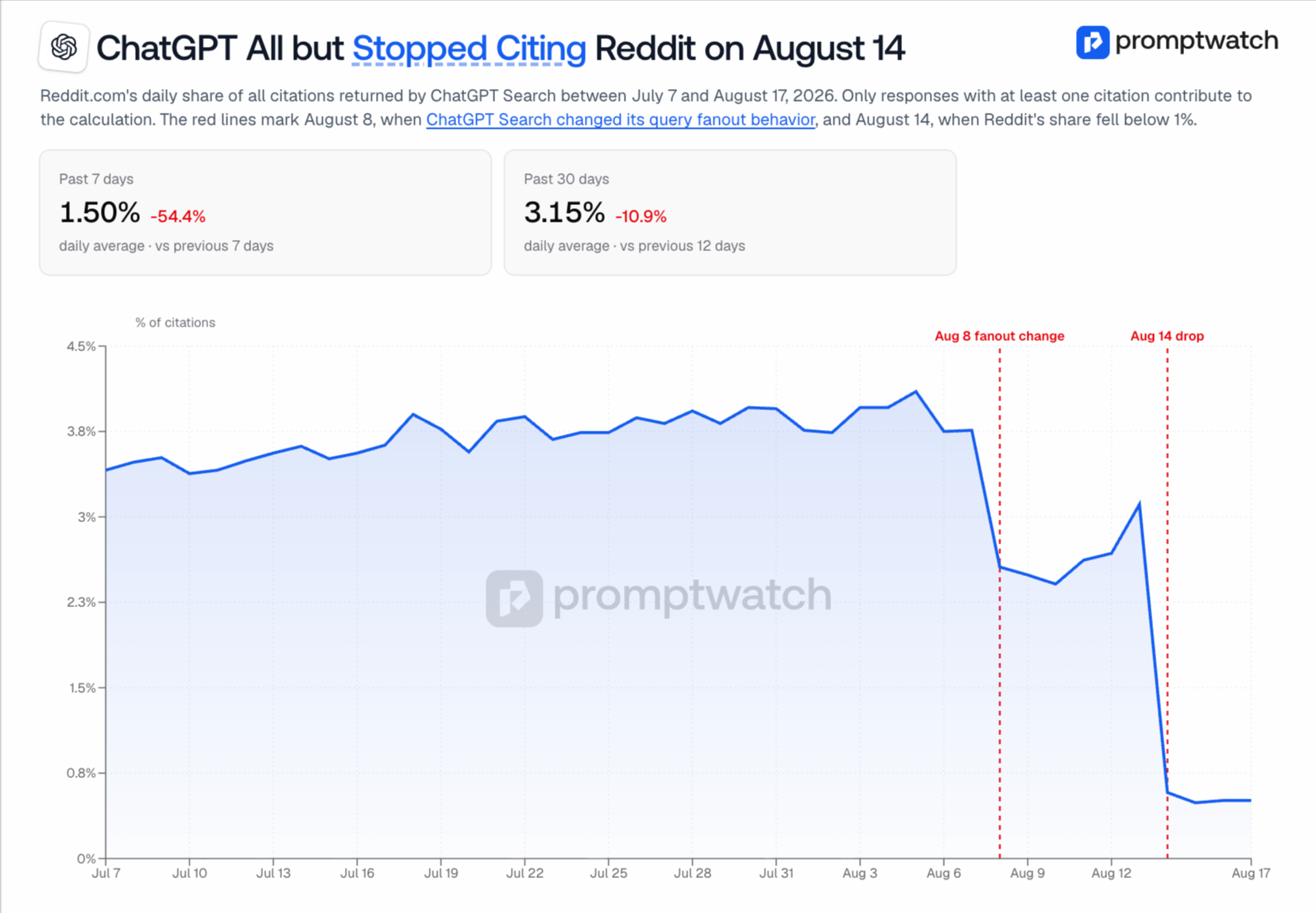
The cause is still unconfirmed, and Promptwatch calls the data provisional.
Whatever the cause, a brand spread across several channels rides out one platform's change.
Traces back to: authority and backlinks.
Social presence, which Search Console now measures
Your social posts already rank in Google.
Since July 2026 you can see how they perform.
Google added platform properties to Search Console in July 2026.
They cover Instagram, TikTok, X and YouTube.
We connected our own YouTube channel the week it launched.
Two days of data showed 35,585 impressions, 1,005 queries and 303 page-one rankings. By July 17, our YouTube content had earned 87 clicks from Google Search.
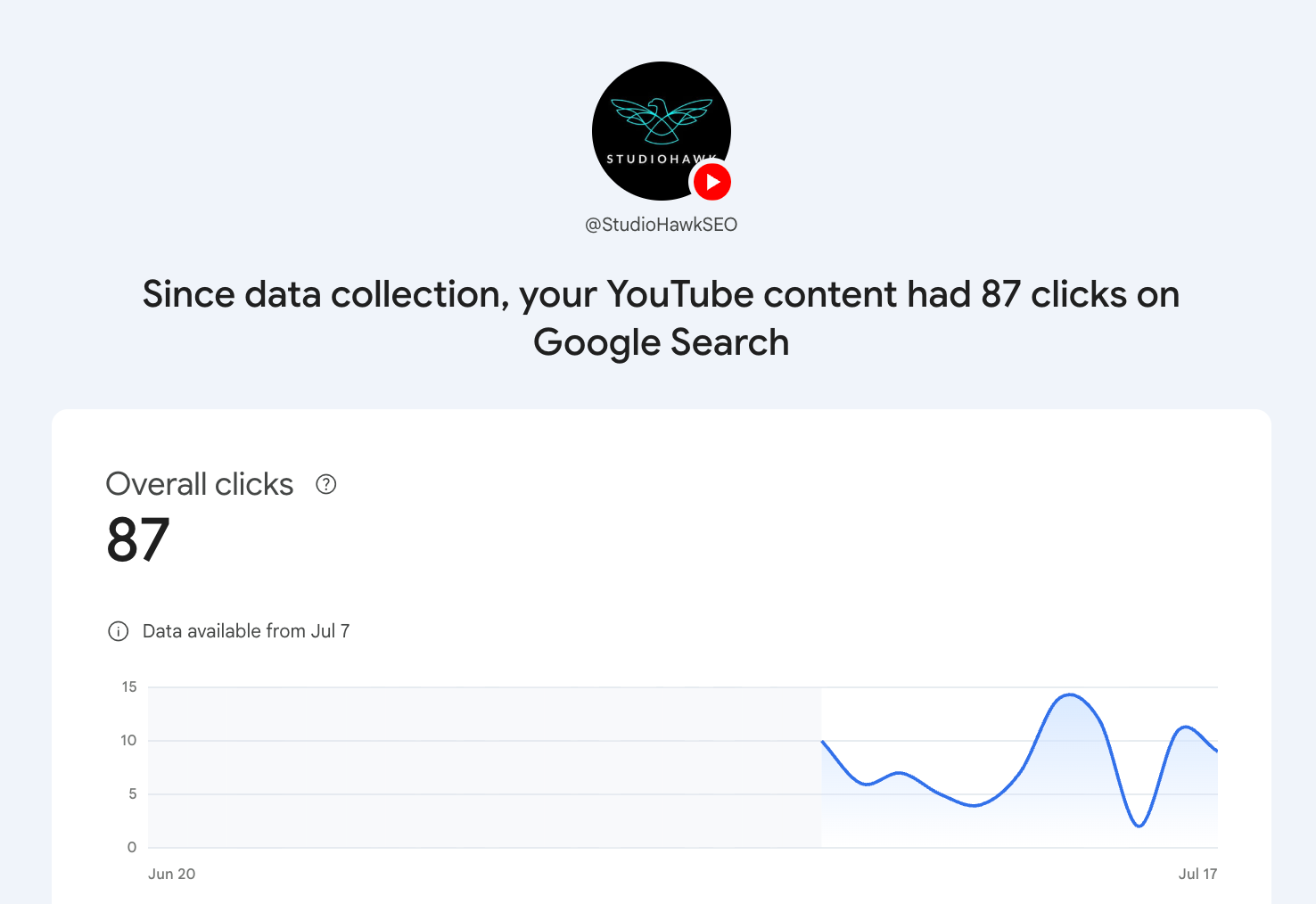
Social content gets seen in Google far more than it gets clicked, so judge it on visibility.
We also found the data is out of reach of every tool, including Google's own Search Console API, so for now it is a manual export. Our guide to ranking social content on Google covers the how.
Traces back to: visibility in search.
Being findable in more than one index
Microsoft runs its own index and its own AI answers, its Bing Webmaster Tools now has an AI Performance report that shows how often your pages are cited in Copilot and Bing's AI answers.
Verify your site there as well as in Search Console.
Traces back to: crawling and indexing.
Content AI crawlers can read without JavaScript
AI crawlers such as OpenAI's GPTBot and Anthropic's Claude crawler read the HTML a page sends and skip its client-side JavaScript, Search Engine Journal reported in 2025.
If your key content only appears after a script loads, those crawlers see an empty page.
Serve your important text in the HTML, and learn about best practices for Javascript SEO.
Traces back to: technical SEO.
The same facts about your business everywhere
AI tools build their picture of your business from every source they read.
If your website, Google Business Profile and directory listings disagree on your services, locations or prices, the answer they give can be wrong.
Keep the facts consistent across the web.
Traces back to: entity and local SEO.
Measuring citations as well as rankings
Rankings show where you sit in search results.
Citations show whether AI answers mention you, track both.
The measurement section below covers the tools.
Traces back to: SEO reporting.
Plenty of what gets sold as GEO is a hack.
Which GEO hacks can you skip?
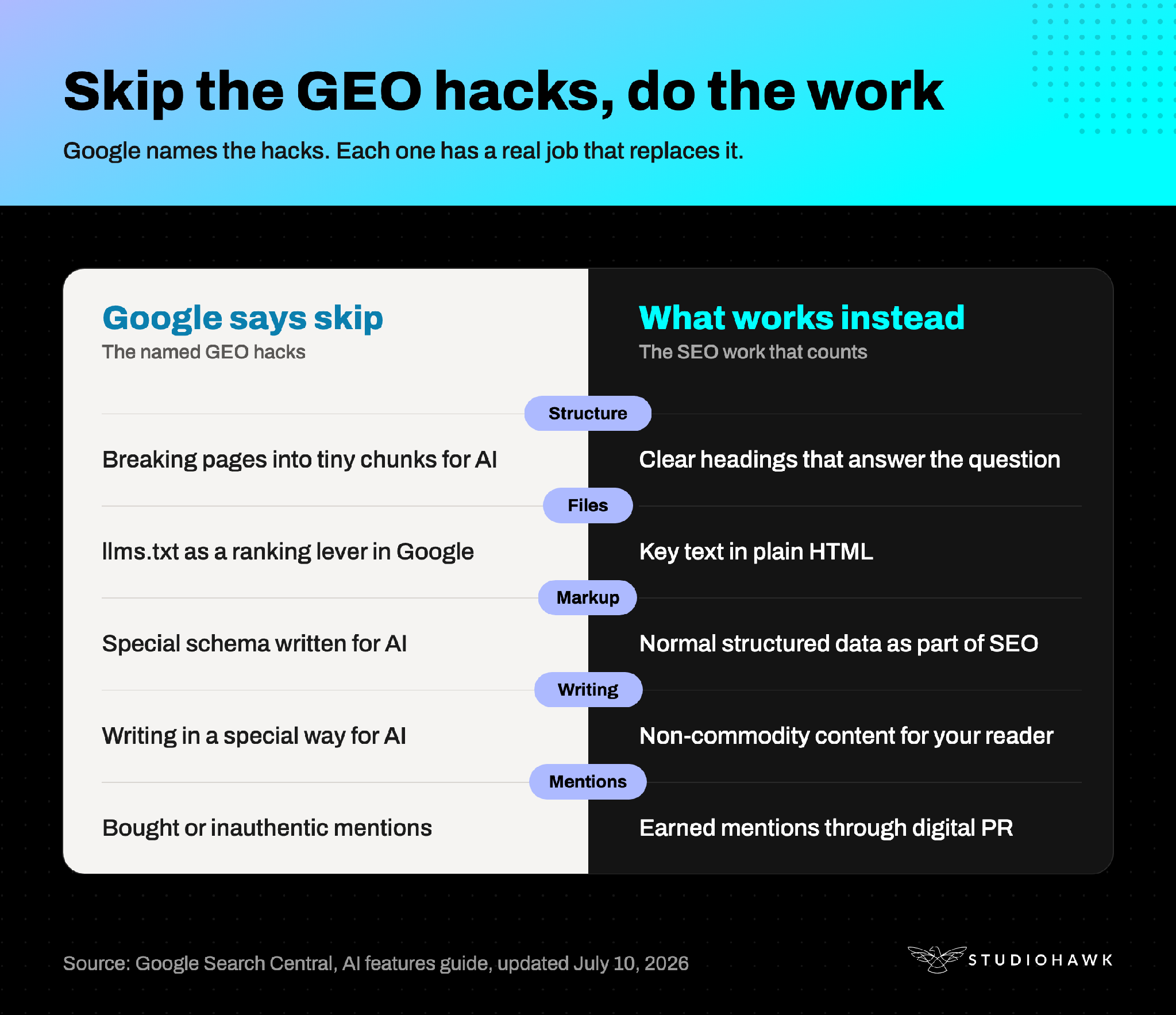
The GEO hacks you can skip are the ones Google lists by name. Its guide tells site owners to "Prioritize effective SEO strategies over 'AEO/GEO hacks'", then names them:
- Breaking content into tiny chunks: Google says its systems understand pages with several topics and show the relevant part.
- llms.txt and other AI files: Google says these files "will neither harm nor help" your visibility in Google Search.
- Special schema for AI: Google says structured data is optional for its AI features, and worth keeping as part of normal SEO.
- Writing in a special way for AI: Write for your reader.
- Chasing inauthentic mentions: Earned mentions work, and bought ones do little.
StudioHawk publishes an llms.txt file, because some services outside Google read it and Google says it does no harm. We treat it as housekeeping, with no ranking promise attached.
The guide covers Google Search only. ChatGPT, Perplexity and other assistants may weigh signals differently, which is one reason the 20% exists.
With the hacks set aside, the next question is who does the work.
Do you need a separate GEO agency?
A separate GEO agency is unnecessary: one team covers GEO and SEO, because they are the same work.
Two teams on one website end up doing the same job twice, or undoing each other.
Three warning signs in a GEO pitch:
- It sells the skip list: chunking, llms.txt or special AI schema as the main event.
- It promises your brand a guaranteed place in AI answers. Nobody controls those.
- It offers to buy mentions on forums or review sites.
Whoever does the work, you still need a way to see whether it is working.
How do you measure GEO?
You measure GEO with your SEO reports plus a view of AI citations. Four sources cover it:
- Search Console for rankings, clicks, and your social platform properties
- Bing Webmaster Tools for citations in Copilot and Bing's AI answers
- GA4 for visits that arrive from AI assistants
- An AI visibility tool for how often each assistant mentions your brand
Analytics only sees the click. A brand can be cited in AI answers every day and barely show up in GA4, so read the four together.
FAQ
Is GEO the same as SEO?
GEO is the same practice as SEO.
Google says optimizing for its AI features is "still SEO", and we put about 80% of GEO down to the same fundamentals.
Do I need a separate GEO strategy?
Your SEO strategy is your GEO strategy. Add the newer 20%, led by digital PR, to the plan you already run.
Does GEO change how I should write?
GEO changes how you write only in the way good SEO already does: answer the question, add something original and show your expertise. Google says writing for your reader is enough.
Which AI platforms should I optimize for?
Optimize for the AI platforms your customers use. In the US that usually means Google's AI Overviews and AI Mode, ChatGPT, Gemini, Perplexity and Copilot. The same fundamentals serve all of them.
Can I measure GEO?
You can measure GEO with Search Console, Bing Webmaster Tools, GA4 and an AI visibility tool. Track citations alongside rankings, because analytics only records the click.
Go further with AI Search:
Our free guide to ranking in AI search shows how to get cited by ChatGPT, Gemini and Perplexity.
To have our team do the work, see our AI SEO services.
Sources
- Google Search Central, Optimizing your website for generative AI features on Google Search, last updated July 10, 2026
- Google Search Central blog, platform properties in Search Console, July 7, 2026
- Google Search Central blog, platform properties roll out globally, July 29, 2026
- Bing Webmaster Blog, AI Performance in Bing Webmaster Tools, February 2026
- Search Engine Journal, Google's JavaScript warning and how it relates to AI search, January 2, 2025
- Search Engine Journal, on Promptwatch's Reddit citation data, August 2026
- StudioHawk URL study, websites in our analytics data, Jan 15 to Jul 14, 2026
- StudioHawk Search Console platform-property export, YouTube, Jul 11, 2026

