TL;DR
- Search has split into three channels: traditional SEO, GEO (AI citations), and AEO (direct answers). Brands need all three working together, not one playbook.
- SEO is the foundation. Technical health and authority still drive most traffic, and GEO or AEO can't work without it.
- GEO wins citations, not clicks. It's about being the source AI engines like Perplexity and AI Overviews pull from and mention.
- AEO wins the single direct answer. Think featured snippets, voice search, and AI assistants, powered by answer-first structure and FAQ/HowTo schema.
- LLMO shapes how AI models represent your brand. It's the deeper layer behind GEO and AEO, built on accurate entity data and authoritative mentions.
- A full strategy braids all three. Strong fundamentals, question-based content, clear entity signals, and ongoing monitoring of how your brand shows up in AI outputs.
The way people search has changed. It’s not just where they search but how, from keyword queries to full conversational questions answered without a click. Most businesses are still running a 100% traditional SEO playbook while search behavior has split across three different channels.
SEO, GEO, and AEO are distinctly different but connected pillars of a modern search strategy. SEO, GEO, and AEO are not competing philosophies. StudioHawk US delivers AI SEO strategy and consulting services that offer the greatest potential for success.
How Search Behavior Is Shifting and Why Three Frameworks Now Exist
Users increasingly bypass the traditional results page entirely. Some users choose to ask ChatGPT, use Perplexity, or find direct answers from Google's AI Overviews.
According to Sparktoro, over 60% of Google searches result in zero clicks. There has been significant growth in the use of AI search tools, including a 122% increase in Perplexity users and a 26% increase in ChatGPT search volume. Google SEO changes have created three distinct optimization targets:
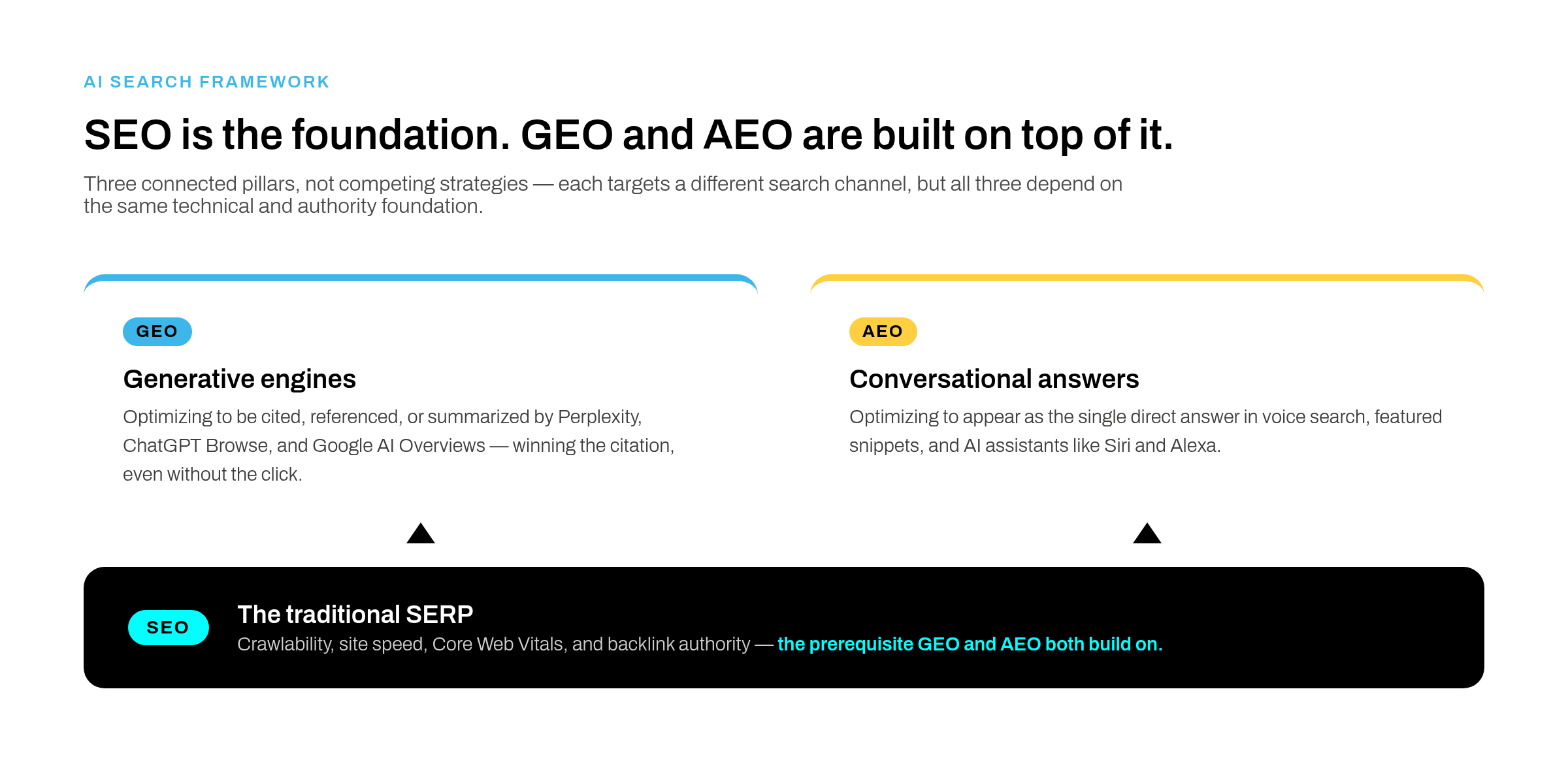
- The Traditional SERP (SEO)
- Generative AI Engines (GEO)
- Conversational Answer Interfaces (AEO)
Each AI SEO strategy has different signals, different content requirements, and different ways to measure success.
What Is SEO (and Why It's Still the Foundation)
Traditional SEO includes optimizing web pages to rank in Google's and Bing's organic results. The blue links users have clicked on for more than 25 years. Traditional SEO addresses the technical health of a website, including:
- Crawlability
- Site Speed
- Core Web Vitals
- On-Page Content Relevance
- Backlink Authority
While some people believe SEO is dead, others know that traditional organic search still accounts for the majority of web traffic. Strong AI SEO fundamentals underpin both GEO and AEO performance. You can't rank in generative AI answers if your site isn't trusted, crawlable, and authoritative. AI SEO is the prerequisite to achieving higher rankings, not the alternative. Explore StudioHawk US Technical SEO services today.
What Is GEO? Generative Engine Optimization Explained
Generative Engine Optimization (GEO) includes optimizing content to be cited, referenced, or summarized by generative AI engines. Tools like Perplexity, ChatGPT Browse, and Google AI Overviews synthesize answers from multiple sources and transcribe the most useful information.
Unlike traditional SEO, where your website aims to win clicks, GEO wins citations in an AI-generated response. With GEO, your brand will be mentioned even if the user never visits your site. GEO boosts content authority and depth while also providing factual accuracy. GEO delivers a structured data markup and states who you are, what you do, and where you operate.
Generative engine crawlers will find your content so it can be cited or linked to by authoritative third-party sources. GEO content is comprehensive, well-structured, and citation-worthy. It answers questions definitively rather than optimizing around keyword density. The challenge many brands face with GEO rankings occurs when the website doesn’t appear in traditional rank trackers. Brands need to monitor AI tool outputs directly to ensure the content accurately represents the company’s service offerings, prices, and ideas.
What Is AEO? Answer Engine Optimization Explained
Answer Engine Optimization (AEO) optimizes content to appear as a direct answer in conversational interfaces. The most common interfaces used are voice search, Google's featured snippets, and AI assistants, like Siri, Alexa, and Google Assistant. Unlike GEO, AEO provides the single definitive answer to a specific question. The goal of GEO is to be cited as one of several authoritative sources in a synthesized response.
AEO delivers concise, direct answers structured around question-based queries. FAQ and HowTo schema markup help search engines and AI engines parse, index, and display the most relevant questions and answers. AEO displays conversational language that mirrors how people speak rather than type. The answers appear in a clear, scannable paragraph structure.
AEO content is displayed in an answer-first structure. It leads with the direct answer, then expands with context. This makes content more likely to be pulled as a featured snippet or voice response. AEO matters most in high-intent question queries such as "What is...", "How do I…”, "What's the difference between…”, and local searches, like ”best SEO agency in Atlanta”.
SEO vs GEO vs AEO: The Key Differences at a Glance
SEO, GEO, and AEO target different search channels. Compare and contrast the differences of each strategy below: 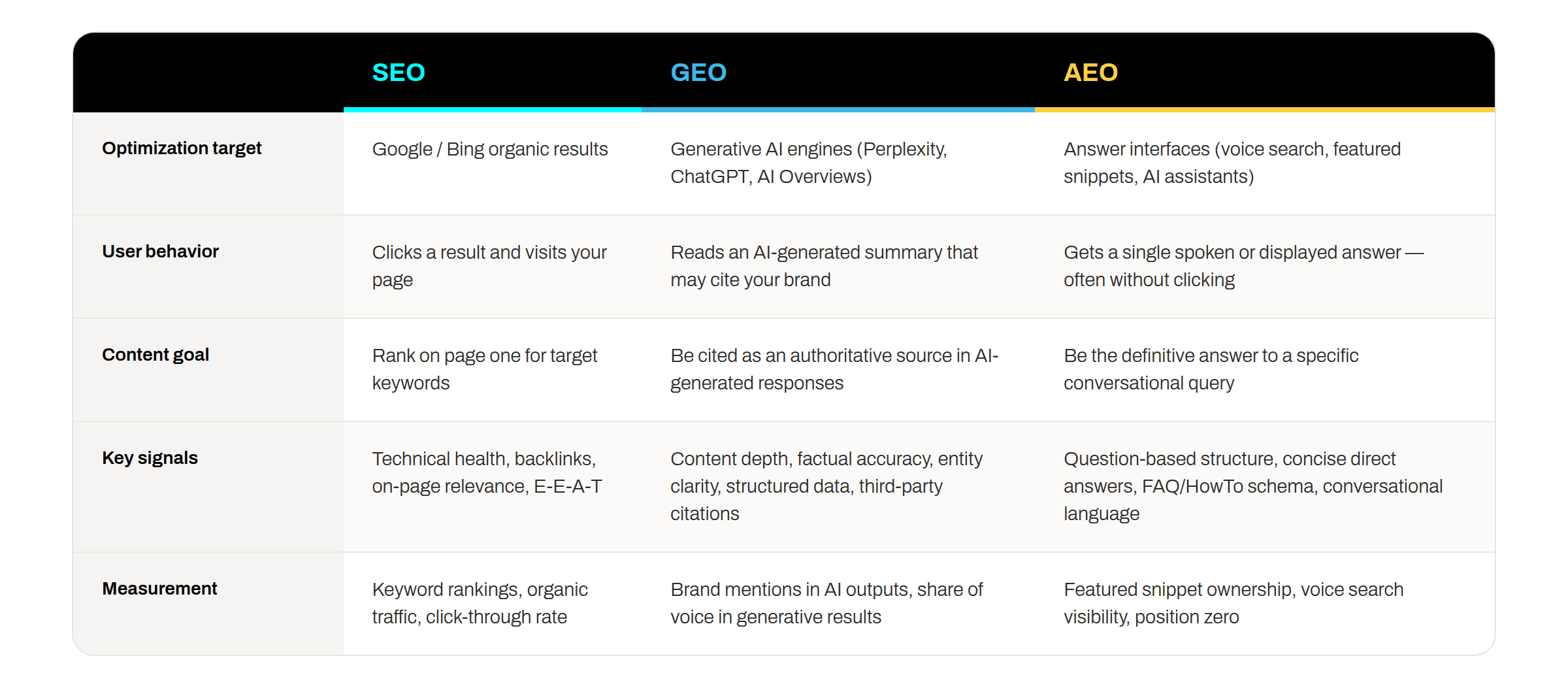
SEO, GEO, and AEO aren't competing strategies. All three strategies share a common foundation of authoritative, well-structured content and signal relevance to each search engine.
What Is LLMO and How Does It Fit In?
LLMO (Large Language Model Optimization) is a newer term used to describe the practice of optimizing content specifically to influence how large language models like GPT-4, Claude, and Gemini represent your brand, products, or subject matter in their outputs. In relation to GEO and AEO, LLMO is the underlying technical discipline. GEO and AEO are the channel-specific applications. LLMO is concerned with how LLMs understand and retrieve your content at the model level. On the practical side of LLMO, it’s important to ensure your brand is represented accurately in training data and retrieval-augmented outputs. LLMOs build entity associations in structured data and across the web. It earns mentions in sources LLMs are known to weigh highly, like Wikipedia, major publications, and industry bodies.
LLMO is still an emerging discipline, and best practices are still evolving. But the fundamentals, including authoritative, entity-rich, accurately attributed content, are consistent with strong SEO and GEO foundations.
How to Build an AI SEO Strategy That Covers All Three
- Begin With Strong SEO Fundamentals: Technical health, E-E-A-T signals, and a clean backlink profile are the prerequisites for GEO and AEO performance.
- Structure Content For All Three Channels: When establishing your content strategy, use question-based H2s and H3s, lead sections with direct answers, and follow with depth and context. This satisfies AEO while giving GEO enough substance to cite.
- Build Entity Clarity: Be unambiguous about who you are, what you do, where you operate, and who you've worked with. Structured data, including Organization, LocalBusiness, and Article schema, help AI systems build accurate associations.
- Earn Third-Party Citations: GEO and LLMO both weight content that the broader web treats as authoritative. This includes coverage in industry publications, directories, and partner sites that will reinforce your brand's presence in AI-generated answers.
- Monitor AI Outputs, Not Just Rankings: Regularly test how your brand appears in Perplexity, ChatGPT, and Claude for your key topics. Gaps in AI visibility are now as strategically important as ranking gaps.
- Publish Consistently On Core Topics: Topical authority signals matter for both traditional SEO and generative AI. A site that covers a subject in depth is more likely to be cited than one with scattered, thin coverage.
Ready to Build a Search Strategy That Covers All Three?
The businesses winning in search aren't choosing between SEO, GEO, and AEO. They're building a strategy that addresses all three. StudioHawk US is the ideal partner with an in-depth understanding of how search is evolving. Pure SEO focus means deeper expertise in exactly this kind of shift. Get Your Free SEO Audit today.

-1.png)